
Void or Dismiss an Invoice
Where the amount, the billable party or the charges on it are wrong, void the invoice rather than editing in your Accounting Sytem and creating discrepancies between both.
Voiding does not delete anything. The invoice stays in the list with a status of Void, and the underlying transactions remain in EPONA.
Void or Dismiss
EPONA offers one of two actions on an invoice, depending on how far it has got:
Void - for an invoice that has already reached your accounting system. It is voided there as well. Dismiss - for a draft invoice that has not yet reached your accounting system. Nothing is sent to your accounting system.
You will only ever see one of the two on any given invoice, so there is no choice to make. Both release the invoice's charges to be invoiced again, and both apply to credit notes as well as invoices — on a credit note the wording refers to releasing its items to be credited again.
Note - Available to Admins and Managers only. Financials is not available to users on the User role.
Where to find it
Void or Dismiss an invoice via;
Financials/Invoices - the three-dot menu at the right-hand end of the invoice row Financials/Invoices - select View / Edit from that menu to open the invoice, then use the Void (or Dismiss) button at bottom right, beside Close Contact profile/Invoices - the three-dot menu at the right-hand end of the invoice row
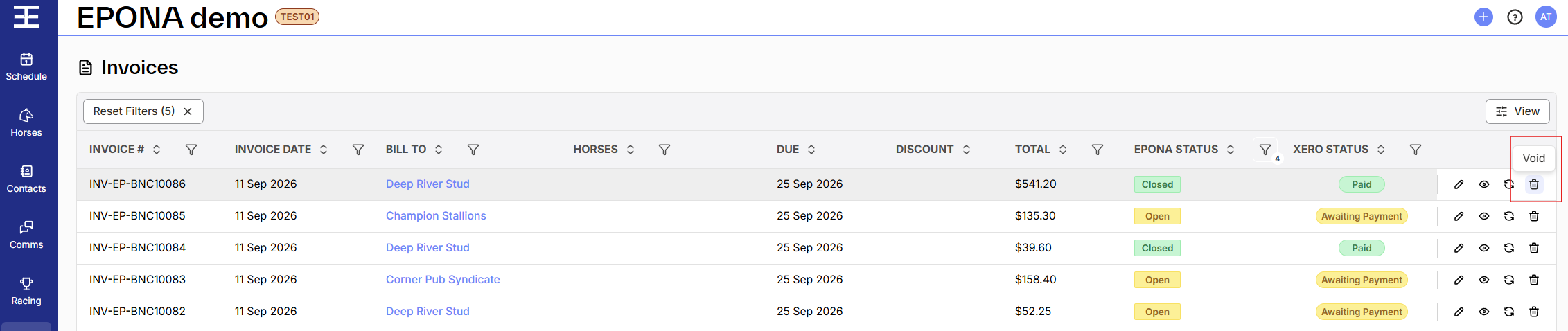
[SCREENSHOT: the Invoices list with the three-dot row menu open, showing Void | invoice-row-menu-void]
To void an invoice
Click Financials at left of screen, then Invoices. Find the invoice in the list, click the bin icon on the right-hand end of its row, then select Void.
A confirmation appears headed Void Invoice (or Void Credit Note for a credit note), reading "This will void the invoice in Xero and release its charges to be invoiced again" — naming whichever accounting system your workspace is connected to. Click Confirm to proceed, or Cancel to leave the invoice as it is.
Where other billable parties hold their own invoices against the same transactions, the confirmation also tells you so, for example "2 other contacts still hold invoices against these transactions — their shares are not affected". Only the invoice you are voiding is reversed; the other parties' invoices stand.
What happens after you confirm
The invoice's accounting status, shown in the Xero Status column (named for your accounting system), becomes Void. Void is no longer offered on that invoice.
The charges are released. On the Transactions view, each affected transaction returns to Approved and is available to invoice again. Where another billable party still holds an invoice for their share, the transaction shows Partially Invoiced instead.
On the Transactions view, hover over the invoice reference against a released transaction to see Voided, or Dismissed where a draft was dismissed.
Note - voiding cannot be undone. To bill the charges again, create a new invoice from the released transactions.
When a void will not go through
Your accounting system has the final say. Xero, for example, refuses to void an invoice that already has a payment or a credit note allocated against it. Where that happens EPONA shows the message from your accounting system and the invoice is left untouched. Reverse the payment or the allocated credit note in your accounting system first, then void the invoice in EPONA.
Note - the Void button is unavailable while your accounting connection is disconnected, because the void has to be carried out in your accounting system. Reconnect under Settings/Account Settings and try again. Dismissing a draft still works while disconnected, because a draft has not left EPONA.
Voiding an invoice is not the same as cancelling a charge
Void reverses the invoice and hands its charges back, ready to be invoiced to someone else or at a different amount. The charges themselves remain.
Where the charge itself should not exist at all, leave the invoice alone and use Cancel Transaction on the Transactions view instead.